After researching all the Marx professional and personal sites I desided to construct a map to make it easy to plan a Marx roadtrip in Chicago.
It can be found here at The Marx Brothers in Chicago.
The Marxes left New York in late 1909 and worked their way west to move to Chicago.
When they got to Chicago, two of the brothers were teenagers and Zeppo was eight.
Chico was yet to join the act. Harpo was in the act, but the harp wasn’t.
They were basically one of a crowd of boy singer acts.
But all that was about to change.
One reason for the move was because their fairly limited act wore out its welcome in most of the small-time vaudeville circuits.
After Groucho, Harpo, and Gummo’s last show as The Four Nightingales in Indianapolis on November 13, 1909 they settled into the south side of Chicago at 4649 Calumet Avenue, where they were enumerated on the April 1910 federal census. It’s now a vacant lot.

They stayed in Chicago until about 1920.
It was to be a pivotal time in their lives, both personally and professionally.
On the personal side, Chicago is where Groucho was first married- to local girl Ruth Johnson, in 1920. They were married at the home of Ruth’s mother and stepfather.
Three years before that, was Chico married in Chicago to Betty Karp, a Brooklyn girl he met in Pittsburgh.
Professionally, Minnie and her sister joined the act. Briefly.
Chico and Zeppo joined the act and Gummo left it.
Harpo stopped speaking started playing the harp on stage.
And they decided to focus on comedy.
Before they bought a house on the south side they were actually looking on the north side.

In 1914 they bought a house at 4512 Grand Blvd. (now Martin Luther King Blvd.)
Here’s a description of the home from a Chicago Tribune advertisement from 19 May 1912 from right after the previous owner, Thomas Hamm, died.

I went to the Cook County Recorder of Deeds and found the mortgage.
Marx.mortgage
You’ll note the name Greenbaum on the documents. He’s the same mortgage-holding Greenbaum whose name Minnie would hiss from the wings when the boys would start cutting up on stage. His parents lived next door to the Marx home at 4510.
It appears the Hamm family sold to Greenbaum in 1909, who rented to the Marxes until they bought it in January 1914.

It appears that Minnie wasn’t planning on doing all the housework.

Seems like Maxine may have been a difficult baby. “Take entire charge”?

Here’s a glimpse of what Frenchie was doing at that time, from the Chicago Tribune of 27 May 1917.

They finally sold the property in 1920.
Before selling the house and moving back to New York they placed quite a few ads selling off various items.
The Scripps-Booth roadster was bought by Groucho for $150 and had pushrod issues, as told in “Groucho and Me.”


Lyon & Healy Harp Factory
Also in Chicago is the Lyon & Healy harp factory at 168 North Ogden Ave., a mile and a half or so from the Loop.

They’ve been making harps on the site since the 1890s. The current building went up in 1928.
In later years it’s where Harpo bought all his harps. By the 1930’s the company would send porters to move his harps from city to city and set it up in his hotel rooms.
According to internet experts who know harps better than I, Harpo played a Lyon & Healy Style 17 in Love Happy and A Night in Casablanca.
He also owned two Lyon & Healy Gold-Gilt Concert Grands, Style 24, notable for their distinctive floral decoration.
When Harpo died on of his harps was donated to the Jerusalem Academy of Music and Dance. As of spring 2018 it was in room 507.
According to the Naples Florida Weekly of 4 Aug 2022 the harpist for the Naples Philharmonic, Dickie Fleisher, owns a Harpo harp.
“These days, he uses a rather famous harp in his performances. It was owned by Harpo Marx and played by the actor in four films, including “A Day at the Races” and “The Big Store.” Mr. Fleisher bought it sight unseen during an out-of-state auction about 25 years ago, though the sellers and therefore Mr. Fleisher didn’t know the instrument’s historical significance. When he received the harp, Mr. Fleisher gave the serial number to the general manager of Lyon & Healy, the famous harp manufacturers, who shared its provenance. Mr. Fleisher called Bill Marx, Harpo’s son, who confirmed that his father had owned only one Lyon & Healy Gold 23.”
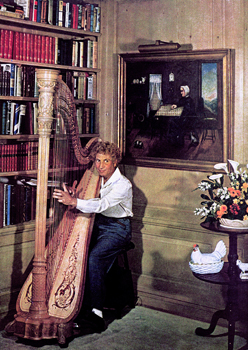
 From The Marxives